
Request a quote or datasheet
Our engineers can help with product selection and application guidance.
Pressure measurement guide
Most machines that care about pressure care about temperature too — and usually at the same point in the circuit. A combined pressure and temperature transducer measures both from a single process connection: one tapping, one cable run, one instrument to install and maintain instead of two. This guide explains how these 2-in-1 sensors work, how to choose between output types, and when separate instruments are still the better engineering call.
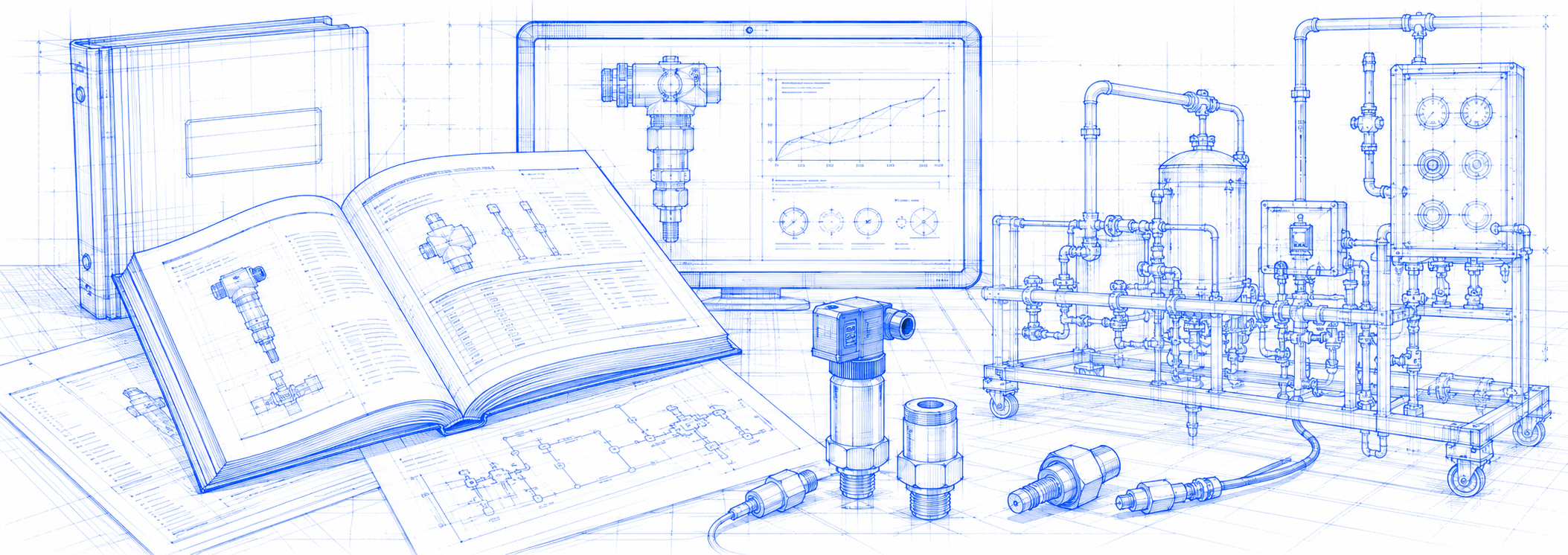
Three reasons, in the order engineers usually meet them. Fewer process penetrations: every tapping is a leak path, a fitting to procure and a hole to machine, so halving them matters on compact manifolds and OEM equipment built in volume. Space and cost: one body, one connector and one cable replace two of each — the reason a domestic pump manufacturer asked us to replace two separate sensors with one customised combined unit. And measurements that belong together: in closed circuits pressure and temperature move together, so measuring both at the same point supports compensation and smarter control than two sensors fitted a pipe-run apart.
A combined transducer pairs a conventional pressure cell with a temperature element in the same housing. On the pressure side, media pressure deflects a sensing diaphragm and the electronics convert that deflection to your output signal. On the temperature side there are two common approaches: a platinum resistance element (PT100 or PT1000) — the industrial standard, with a defined resistance-versus-temperature curve your PLC or transmitter input reads directly — or an NTC thermistor, a lower-cost element whose steep resistance curve suits OEM controllers designed around it, common in automotive and HVAC electronics.
4-20 mA pressure with PT100 or PT1000 temperature is the industrial pattern: a noise-immune current loop for pressure, a standard RTD input for temperature, long cable runs and plant-standard wiring. Ratiometric voltage pressure with NTC temperature is the OEM pattern: the sensor rides the controller's 5 V supply and the NTC feeds an input your board already has, giving a lower cost per point at volume. Match the sensor to the system reading it, not the other way round — and if you are unsure, send us the controller's input specification with the enquiry.
Choose separate pressure and temperature instruments when the two measurement points are genuinely different places in the process, when one parameter needs a specification the combined unit cannot carry (very high accuracy temperature, or pressure ranges beyond the combined family), or when independent replacement matters — a combined unit is one part to change even if only one measurement has drifted. Honest sizing beats forcing a 2-in-1 where it does not fit.
The QPress QLS-COMBO 3100 Series is the industrial unit: 0-40 bar spans, plus or minus 0.5 % FS (0.25 % optional), 4-20 mA pressure output with PT100 or PT1000 temperature output, stainless construction, G1/4 connection, DIN 43650 connector, IP65, media to +100 degrees C. The QPress QOM-COMBO 1200 Series is the OEM and automotive unit: 0-40 bar, 0.5-4.5 V ratiometric pressure output with NTC temperature sensing, compact 304-stainless body, G1/4, M12x1.5 or M10x1 threads, automotive-style plug, media -30 to +130 degrees C. Both are supplied across the UK and EU with datasheets on each product page, and samples for OEM development can be arranged — customised variants covering connector, curve matching and lead length are how the pump-manufacturer project above started.
The pressure side performs like the equivalent single-function transducer (plus or minus 0.5 % FS on our industrial unit). The temperature element reads at the process connection — for most machine-control duties that is exactly where you want it.
Same platinum technology; PT1000's higher base resistance makes lead resistance proportionally less significant in 2-wire hookups. Your controller's input card usually decides.
Yes — matched NTC curves, connectors and pin-outs to make the sensor plug-and-play is a service we have delivered for OEM customers; ask with your enquiry.
Browse pressure transducers & transmitters →
Unsure? Send the application → — an engineer responds within one working day.
Our engineers can help with product selection and application guidance.