
Request a quote or datasheet
Our engineers can help with product selection and application guidance.
Selection guide
Engineers often use the two names interchangeably, but the difference matters when you specify. Here is the practical distinction, and how to choose.
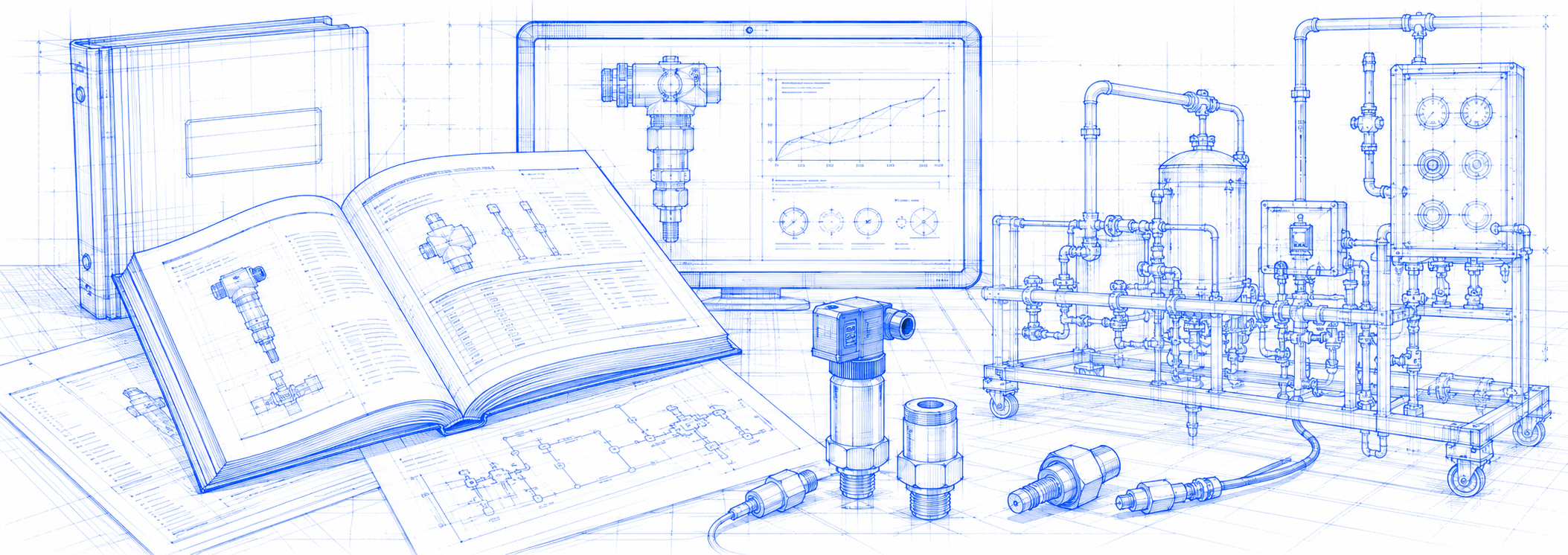
Both convert pressure into an electrical signal. A transducer outputs a raw or lightly conditioned signal, typically millivolt or voltage, and relies on the receiving system for processing. A transmitter includes built-in signal conditioning and drives a standardised output such as 4–20 mA, often with digital protocols like HART or Modbus on top. Transmitters suit plant control loops and long cable runs; transducers suit OEM builds and test systems that do their own processing.
4–20 mA is the industrial default: it tolerates electrical noise over long cable runs and its live zero makes fault detection easy. Voltage outputs suit short runs into controllers, data loggers and embedded systems. Digital options, HART over the 4–20 mA loop or Modbus RTU over RS485, add configuration, diagnostics and multi-parameter data for networked plant.
±0.5 % FS is the workhorse class for general monitoring and control. Specify ±0.25 % FS or better for test benches and tight process control, and per-cent-of-reading instruments where accuracy must hold across a wide turndown. Higher accuracy raises cost, so match the class to what the process genuinely needs.
Browse pressure transducers & transmitters →
Unsure? Send the application → — an engineer responds within one working day.
Our engineers can help with product selection and application guidance.